Which Diesel Performance Parts Actually Improve Towing Capacity?
When a truck owner talks about “towing capacity,” they are often conflating two different things: the legal gross combined weight rating (GCWR) set by the manufacturer and the actual mechanical ability of the truck to move a heavy load without overheating or stalling. While you cannot legally change the chassis rating of your vehicle, you can significantly improve the experience of towing-reducing engine strain, improving fuel economy under load, and ensuring the vehicle remains controllable on steep grades.
For those hauling heavy equipment, livestock trailers, or oversized campers, the goal isn’t just raw horsepower; it is torque delivery and thermal management. Here is a breakdown of which upgrades provide a measurable return on investment for towing.
Enhancing Torque and Low-End Power
Towing is won or lost in the low-end torque curve. If your engine has to downshift constantly to maintain speed on an incline, you are increasing wear on the transmission and risking overheating.
Cold Air Intakes and Exhaust Systems
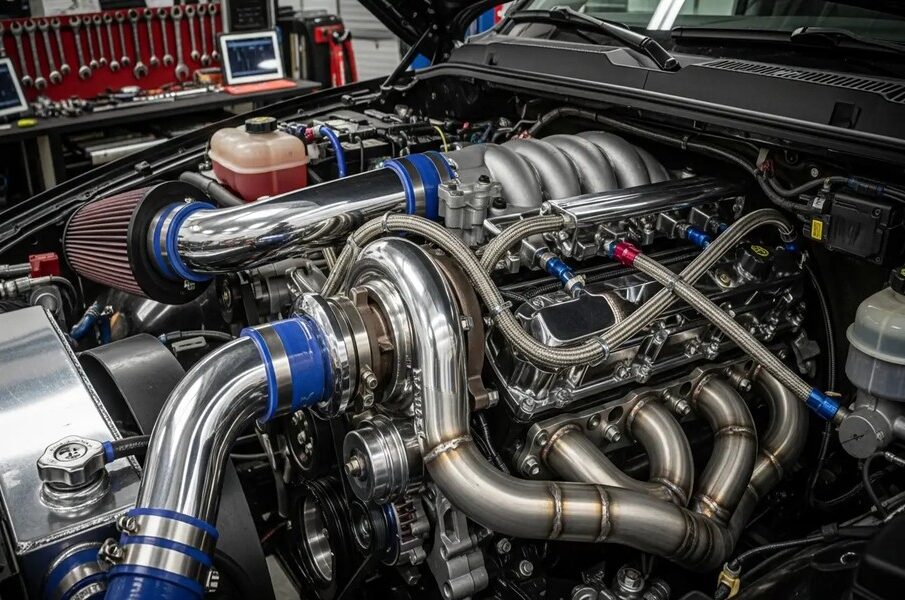
An engine is essentially an air pump. To generate more torque, it needs to breathe more efficiently. High-flow intake systems and mandrel-bent exhaust pipes reduce the restriction the engine faces when pushing out exhaust gases. For a tower, this means the engine doesn’t have to work as hard to maintain a specific RPM, which lowers Exhaust Gas Temperatures (EGTs) during long climbs.
Tuners and ECU Calibration
Modern diesel engines are often detuned from the factory to meet a wide variety of global emissions standards. A custom tune can optimize the fuel-to-air ratio and adjust shift points in the transmission. By shifting the torque peak lower in the RPM range, you can pull heavier loads away from a dead stop with less clutch or torque converter slip.
Upgraded Turbochargers
While a larger turbo can increase top-end speed, towing benefits more from a turbo that reduces “lag.” A more efficient turbocharger ensures that the boost is available the moment you hit the pedal, preventing the sluggish feeling often associated with heavy trailers on highway on-ramps. To achieve these results, many owners invest in high-quality diesel performance parts that prioritize durability under sustained high-pressure loads.
Thermal Management: The Secret to Long-Haul Stability
The biggest risk when pushing a diesel truck to its limits isn’t a lack of power, but the accumulation of heat. Heat is the primary enemy of diesel engines and transmissions.
Heavy-Duty Cooling Systems
When towing a 15,000-lb trailer through a mountain pass in July, the factory radiator may struggle. Upgrading to a high-capacity aluminum radiator or adding an auxiliary transmission cooler is one of the most practical moves a tower can make. If the transmission fluid exceeds its operating temperature, the fluid thins, lubrication fails, and the transmission can fail prematurely.
EGT Gauges and Monitoring
You cannot manage what you cannot measure. Installing a dedicated Exhaust Gas Temperature (EGT) gauge allows the driver to see exactly when the engine is under too much stress. If the EGTs spike, the driver knows to back off the throttle or downshift before the engine sustains permanent damage.
Stability and Control Upgrades
Power is useless if the truck cannot keep the trailer in a straight line. Improving the “capacity” of a truck also involves the suspension’s ability to handle the tongue weight without sagging.
Suspension and Air Springs
Excessive tongue weight causes the front end of the truck to lift, which reduces steering precision and braking efficiency. Adding helper springs or airbags allows the driver to level the load. This keeps the center of gravity stable and prevents the “porpoising” effect-the rhythmic bouncing that occurs when hitting bumps at highway speeds.
Braking Upgrades
Stopping a heavy load is more critical than starting it. Upgrading to heavy-duty brake pads and high-performance rotors reduces brake fade. Brake fade occurs when the pads overheat and lose their friction coefficient, significantly increasing stopping distances. For those frequently towing in mountainous terrain, this is a safety requirement rather than a performance luxury.
Summary of Practical Gains
Improving towing capacity is a holistic process. While a tuner provides the power to move the load, the cooling system ensures the engine survives the trip, and the suspension ensures the vehicle remains safe. By focusing on torque delivery and thermal regulation, owners can transform a struggling work truck into a reliable long-haul machine.